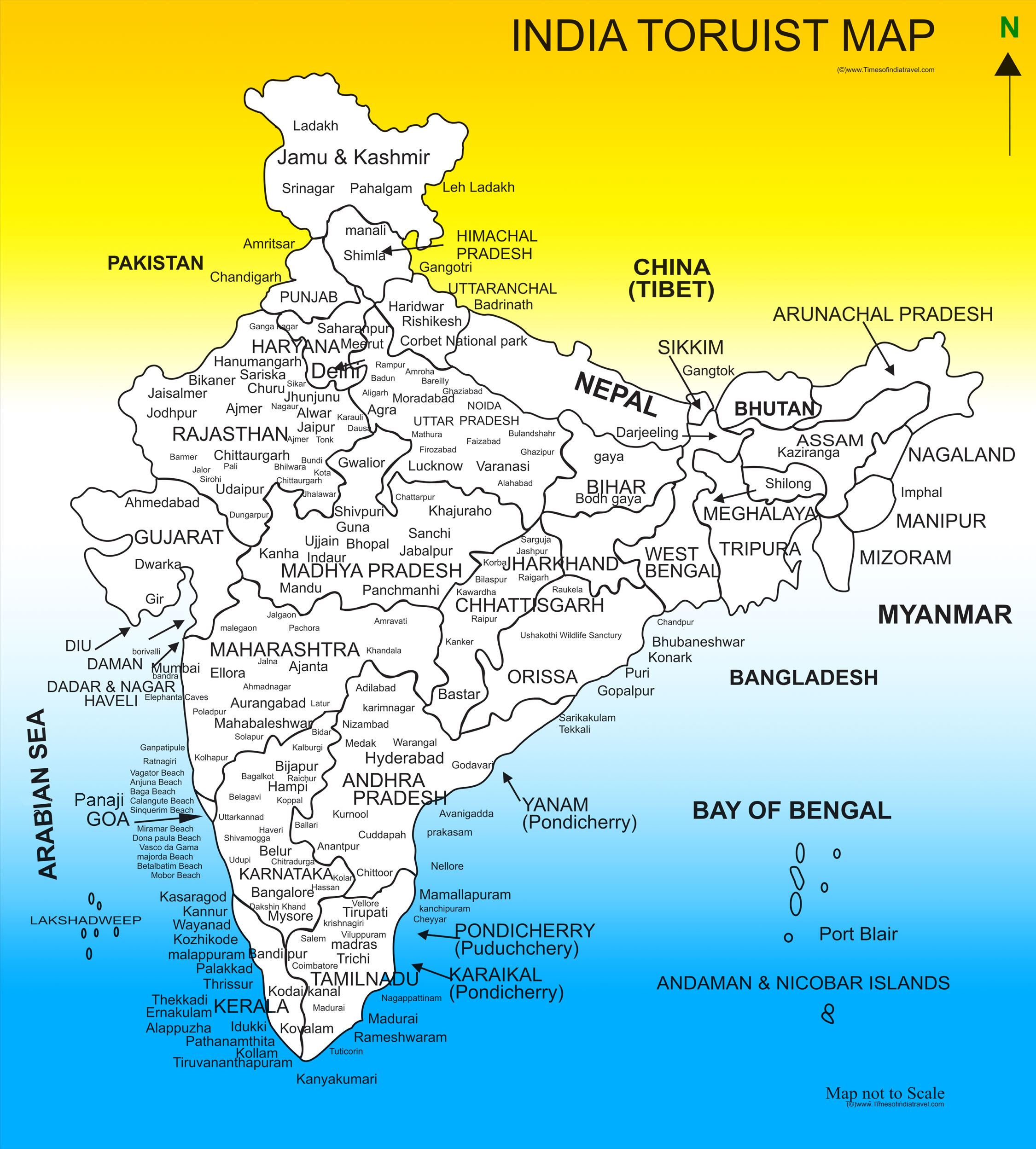
Ever looked at a map and felt like something was... off? It happens more than you’d think. Especially when you’re hunting for a map of the world India edition versus one printed in, say, London or Washington D.C. Maps aren't just cold, hard facts. They're political statements.
India sits there in South Asia, a massive, kite-shaped peninsula stabbing down into the Indian Ocean. It’s huge. It’s the seventh-largest country on the planet, but size isn't the whole story. When you zoom in on a digital map or unroll a paper one, the borders you see depend entirely on which government’s "official" version you’re looking at. This isn't just about geography; it's about identity, history, and some very long-standing arguments.
The cartographic headache of India’s borders
Most people just want to see where New Delhi is or how far Mumbai is from the coast. Simple, right? Not really. If you open Google Maps inside India, you’ll see solid lines around the entire Jammu and Kashmir region. However, if you access that same map of the world India from a server in the United States or Europe, those lines suddenly become dotted.
Why the change?
Because of the "Line of Control" (LoC) and the "Line of Actual Control" (LAC). These aren't just fancy names. They represent areas where India, Pakistan, and China have been locked in a territorial stalemate for decades. India claims the entire former princely state of Jammu and Kashmir as its own. Pakistan claims a significant portion of it. China sits on the Aksai Chin plateau in the east.
When you look at a global map, these disputed zones are often shaded differently or marked with dashes to indicate that "it's complicated." But for India, those borders are a matter of national sovereignty. In fact, the Indian government has strict laws about this. Publishing a map that doesn't show the entirety of Kashmir as part of India can actually land you in legal trouble within the country. It’s that serious.
Positioning India in the global landscape
Look at the map of the world India again. Notice the neighborhood. To the north, you’ve got the Himalayas—the literal roof of the world. These mountains don't just look pretty; they act as a massive climate barrier and a historical wall. They’ve kept the freezing Siberian winds out and, for a long time, kept invading armies at bay.
💡 You might also like: Rock Creek Lake CA: Why This Eastern Sierra High Spot Actually Lives Up to the Hype
Then you have the coastline. It's over 7,500 kilometers long.
India isn't just a country; it’s a maritime gateway. To the west lies the Arabian Sea, connecting India to the Middle East and Africa. To the east, the Bay of Bengal leads toward Southeast Asia. This central position in the Indian Ocean is why the country has been a trade hub for literally thousands of years. From the ancient spice trade to modern-day shipping lanes, India is the fulcrum of the Eastern Hemisphere.
The projection problem: Is India actually that small?
We need to talk about the Mercator projection. You know the one—the map we all used in school where Greenland looks bigger than Africa. It’s a lie. Well, a mathematical distortion, anyway.
Because the Earth is a sphere and paper is flat, mapmakers have to stretch things to make them fit. The Mercator projection stretches the areas near the poles and shrinks the ones near the equator. Since India is closer to the equator, it looks way smaller than it actually is when compared to Europe or Russia.
- India’s actual land area is about 3.28 million square kilometers.
- It is roughly one-third the size of the entire United States.
- You could fit several European countries inside a single Indian state like Rajasthan or Uttar Pradesh.
If you look at a Gall-Peters projection—which tries to keep the sizes of continents accurate—India looks much more imposing. It regains its true stature as a subcontinent.
Reading the physical map: Beyond the lines
A map of the world India doesn't just show where people live. It shows how the earth behaves. If you look at a topographical map, the colors tell a story.
📖 Related: Deer Ridge Resort TN: Why Gatlinburg’s Best View Is Actually in Bent Creek
The deep browns of the North are the high-altitude peaks of the Himalayas. Just below that, you see a massive band of lush green. That’s the Indo-Gangetic Plain. It’s one of the most fertile places on Earth, fed by the Indus, Ganges, and Brahmaputra rivers. It's no wonder over 400 million people live in this single strip of land. It’s basically the "breadbasket" of the region.
Further south, the map turns into a rugged plateau known as the Deccan. It’s flanked by the Western Ghats and the Eastern Ghats. The Western Ghats are a biodiversity hotspot—older than the Himalayas and home to species found nowhere else. When you see a map that shows "relief" or "elevation," you start to understand why India’s weather is so chaotic. The mountains trap the monsoon clouds, dumping rain on the coast while leaving the interior dry.
Digital maps and the 2026 reality
In 2026, we don't really use paper maps for much besides decoration. We use GIS (Geographic Information Systems) and real-time satellite data. Digital versions of the map of the world India are now incredibly layered.
You’ve got:
- Bhuvan: India’s own geo-platform developed by ISRO (Indian Space Research Organisation). It provides high-resolution imagery specifically for the Indian subcontinent.
- Google Earth: Great for 3D views, though it still navigates the political minefield of "dotted borders" depending on your IP address.
- OpenStreetMap: A community-driven map that often shows the most granular details of rural Indian roads that big tech companies miss.
The accuracy has reached a point where we can track the receding glaciers in the Himalayas or the expansion of urban sprawl in Bengaluru in near real-time. This isn't just for navigation; it's for survival. With climate change shifting monsoons, these maps help predict floods and manage water resources.
The cultural map: Where the lines blur
The funny thing about a map of the world India is that it doesn't show the "human" borders. India has 22 official languages and thousands of dialects. If you drew a map based on language, it would look like a kaleidoscope.
👉 See also: Gomez Palacio Durango Mexico: Why Most People Just Drive Right Through (And Why They’re Wrong)
South India (the Dravidian linguistic group) looks and sounds completely different from the North (Indo-Aryan group). Then you have the Northeast—seven states connected to the rest of the country by a tiny "Chicken's Neck" corridor. Culturally and geographically, the Northeast feels more like Southeast Asia. Maps often fail to convey this internal diversity, treating the country as one giant monolith when it's really a collection of mini-nations.
What to keep in mind when viewing Indian maps
When you're looking at India on a global scale, you have to be aware of the "source." A map printed in China will show Arunachal Pradesh (an Indian state) as "South Tibet." A map from Pakistan will show all of Kashmir as "disputed."
The Survey of India is the official authority for mapmaking in the country. Since 1767, they’ve been the ones setting the standard. If you’re doing business in India or writing a textbook there, their version is the only one that matters legally.
Actionable steps for accurate map usage
If you're using a map of the world India for research, travel, or school, don't just settle for the first Google image result. Follow these steps to get the full picture:
- Check the Projection: Use "The True Size Of" tool online to drag India over Europe or North America. It’ll blow your mind how much the Mercator projection shrinks it.
- Verify the Source: If you need the official Indian perspective, go to the Survey of India website. This is crucial for any formal documentation or official projects.
- Use Layers: For travel, don't just look at roads. Look at a "Terrain" layer to understand why a 200km trip in the mountains takes 10 hours while the same distance on the plains takes 3.
- Acknowledge Disputed Zones: When presenting to an international audience, it is standard practice to use maps that highlight disputed territories with dotted lines to remain neutral, whereas for an Indian audience, use the integrated map to avoid offense and legal issues.
- Look at the "Water Map": Study the river systems. India's geography is defined by its water. Understanding where the Ganges or the Godavari flows tells you more about the country's economy and soul than any political border could.
Geography isn't static. It’s a living, breathing thing shaped by tectonic plates and human politics alike. Whether you're a traveler or a student, seeing India on the world map is about more than just finding a location—it’s about understanding a massive, complex piece of the global puzzle.